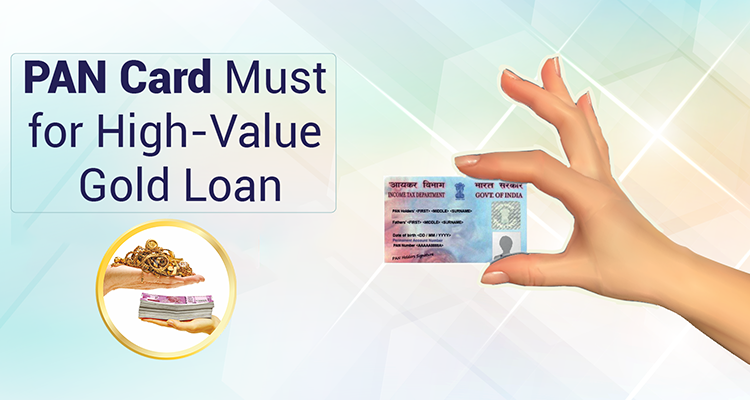
PAN Card Must For High-Value Gold Loan
Table of Contents
A gold loan is a type of secured debt in which the borrower pledges their personal or family's gold jewellery as security in exchange for quick cash. The gold jewellery is held by the lender in escrow as collateral for offering a loan. The jewellery is given back to the borrower once the money has been repaid.
The value of the gold jewellery is very important to determine the amount of loan to be extended. An expert conducts the valuation exercise, taking into account the jewellery weight and purity of the yellow metal. Since there is no established pricing system or benchmark for other precious stones, the valuer does not take their weight into account.
The loan is given after deducting a margin, which means that the value of the jewellery given as collateral is not the amount that can be borrowed. To cover the value of the collateral, lenders maintain a buffer to account for unexpected price drops. However, such situations are rare and the buffer is usually enough to cover the loan dues.
A gold loan is an easy and convenient method of raising capital, especially for immediate and short-term requirements. Such loans are gaining popularity in India as gold is a common asset in most Indian households and has been accumulated over ages. Also, it does not require extensive documentation.
Therefore, gold loans often prove to be saviour for people who need urgent capital, whether to pay off their medical bills or tide over a cash crunch in their small business and so on.
Eligibility For A Gold Loan
Any lender who offers a gold loan will base the loan size on the total weight of the gold. The purity of the jewellery must be above 18 karats of gold to get the maximum loan amount. As specified earlier, the weight of other items, such as stones, gems, diamonds, etc., is not included when determining the total weight of the gold ornaments. Only the ornament’s gold content will be calculated.
• Any individual who has gold jewellery is eligible to apply.
• The applicant should be in the age group of 18 years to 60 years.
• A loan against gold is granted to professionals, self-employed, business owners, and other
• Individuals, that have the capacity to repay the borrowed amount.
• As it is a secured loan with the lender having possession of the asset, a poor credit score usually does not have a great bearing on the approval of such a loan.
Documents Required For Gold Loan
Document submission is part of the Know Your Customer (KYC) norms and checks as mandated by the Reserve Bank of India for all commercial banks and non-banking finance companies (NBFCs). Here is a quick check list of documents from the borrowers:
• Aadhaar card (Mandatory)
• Document of identity proof (Any one of these: PAN card, Passport, Driving License, Voter’s ID)
• Document of address proof (Any one of these: Passport, Driving License, Ration Card, Electricity Bill)
PAN Card
The Permanent Account Number (PAN) card, issued by the Income-Tax Department, is a critical document for income verification and credit check of the applicant.
At present, the PAN card is not mandatory to avail gold loan, although it may provide some extra comfort to the lender about the borrower’s financial position and repaying ability. However, some lenders ask for the submission of the PAN card for high-value gold loans.
The rules may, however, soon change as the working group of the Reserve Bank of India recently recommended the gold loan companies to ask for the PAN card of borrowers opting for gold loans of more than Rs 5 lakh.
Conclusion
A gold loan is one of the best forms of short-term borrowing. This is due to the ease of process and minimal documentation required when taking out a loan as long as the gold ornament's value is greater than the amount borrowed.
Other than the gold, one needs to submit certain documents as identity and address proofs. While it is not necessary to submit a PAN card for low-value gold loans, lenders may ask the borrower to submit the PAN can for higher-value loans above Rs 5 lakh as recommended by the Reserve Bank of India.
Many banks and financial institutions such as IIFL Finance offer instant gold loans following a simple and easy KYC and document verification process.
In fact, if you need a gold loan, you can provide just your Aadhaar number and IIFL Finance representatives can complete the KYC process electronically on their tablets and no other document will be required.
For borrowers in rural areas, IIFL Finance also accepts the job card provided under the National Rural Employment Guarantee Scheme as an address and identity process.
Frequently Asked Questions
Is a PAN card mandatory to apply for a gold loan?
As per the recent RBI guidelines for 2025–2026, for gold loans exceeding ₹2 lakh, submission of a PAN card or Form 60 is mandatory to comply with tax regulations. While KYC documents such as identity and address proof are required for all gold loans, higher-value loans usually involve additional documentation and closer scrutiny.
Why do lenders ask for a PAN card for high-value gold loans?
Lenders request a PAN card for high-value gold loans to comply with RBI regulations and tax laws, and to verify the borrower’s financial background and repayment capacity. This ensures proper monitoring of high-value loans. Borrowers still benefit from minimal documentation, quick loan approval, and safe release of pledged gold upon repayment.
What is the primary purpose of giving my PAN for a Gold Loan?
The major objective of presenting a PAN card is to provide lenders extra confidence in the borrower's financial situation and repayment capabilities, especially for high-value loans. While not required for lower loan sums, PAN input facilitates verification and evaluation.
Can non-PAN holders still get a gold loan?
Yes, non-PAN holders can still apply for a gold loan by presenting other legitimate identification documents such as an Aadhaar card, passport, driver's license, or voter's ID. PAN is only requested for a larger loan amount against their gold.
Disclaimer : The information in this blog is for general purposes only and may change without notice. It does not constitute legal, tax, or financial advice. Readers should seek professional guidance and make decisions at their own discretion. IIFL Finance is not liable for any reliance on this content. Read more