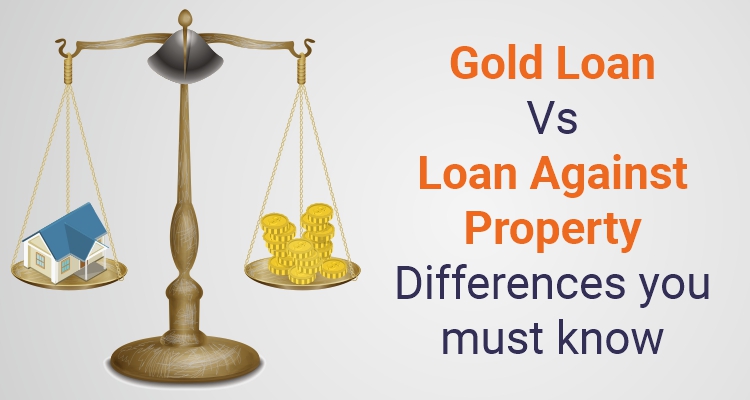
Gold Loan Vs. Loan Against Property - Differences You Must Know
Table of Contents
Life is an endless cycle of ups and downs where the need for capital is constant. Whether to cover personal expenses or invest in a business to earn profits, people need adequate funds to ensure the effective coverage of expenses. Most people raise capital through various loan products. Two of the most widely utilised loan products are a loan on gold jewellery and a loan against land property.
Gold Loan Vs. Loan Against Property - What’s The difference?
Here are the most distinctive differences between a loan on gold jewellery and a loan against a house property:Loan Amount
Before applying for either loan, analyse the current value of the gold ornaments and the house property. Lenders such as banks and NBFCs approve the loan amount based on the value of the gold or the immovable asset, which is generally 75% of the total value. Analysing both assets will determine the one with the higher weight and fetch you the highest loan amount.Loan Tenure
A gold loan has a tenure of up to 24 months, within which the borrower has to repay the loan amount. However, a loan against property is a long-term loan with a tenure of up to 18 years.Collateral
Gold loans require pledging gold ornaments as collateral, while a loan against property requires pledging an immovable asset such as a house or land as collateral. Hence, gold loans are considered more flexible and quick than loans against property.Approval and Disbursal
The application process for a gold loan is completely online and is quick and straightforward. Lenders approve gold loans within 5 minutes of application and disburse the loan amount into the bank account.The application for a loan against property is extensive. It may take days to approve, and the lender disburses the loan amount into the borrower’s bank account.
Interest Rate Charged On Loans
Gold loans come with fixed interest rates. Generally, lenders offer you multiple repayment schemes to choose from. The repayment period plays a role in deciding the charged interest rate. Interest rates on gold loans fluctuate between a median range of 9.24% to 26%, depending upon the financial institution.
Secured loans against property have fixed and floating interest rates. Fixed interest rates do not change with market fluctuations. However, floating interest rates are volatile and keep altering with a shift in market trends. The fixed interest rate on LAP varies according to the market.
Eligibility Criteria
Most lenders do not perform stringent background checks before processing gold loans. You can quickly get a gold loan with an average credit score as lenders do not rely much on your credit history. They pay attention to the weight, market price, and purity of the pledged gold.
The requirements for LAP eligibility involve many complex procedures. Lenders assess your application based on factors like income, property value, existing debts, age, employment status, and credit history.
Loan Processing Time
A gold loan is one of the most trusted resources for unplanned cash requirements. These loans are quick to obtain as they follow a simple processing system. Once the lender is satisfied with the pledged gold’s purity and has ascertained its market price, they process your loan application quickly.
The LAP loan's processing period is more extended than a gold loan as lenders prefer to verify the documents of the mortgaged property keenly. Therefore, the verification and registration procedure adopted in LAP are pretty time-consuming.
Repayment Period
Gold loan lenders allow you to choose between monthly, quarterly, or yearly EMI payments. The length of your repayment plan determines the EMI amount. A shorter repayment scheme can have a higher EMI than a longer one.
Loans against a property usually have a longer repayment tenure that exceeds 20 years. Therefore, the LAP will be a superior option for securing a hefty loan at an affordable interest rate and a feasible repayment period.
Both are secured loans, but their suitability depends on urgency, loan amount, and asset type. A gold loan is faster to avail with smaller ticket sizes, while LAP is ideal for higher funding with longer tenures.
|
Aspect |
Gold Loan |
Loan Against Property (LAP) |
|
Collateral |
Based on purity, weight, and gold value (usually lower amounts) |
Based on property market value (larger loan amounts) |
|
Processing Time |
Quick disbursal, often within hours |
Longer due to valuation, legal checks, and documentation |
|
Repayment Tenure |
Short to medium-term (up to 3 years) |
Long-term (up to 15–20 years) |
|
Interest Rate |
Usually higher than LAP |
Generally lower than gold loan interest rates |
|
Eligibility |
Minimal documentation; no income proof needed |
Requires income documents, property papers, and CIBIL check |
|
Best For |
Urgent short-term cash needs |
Large expenses like business expansion, education, or medical needs |
Avail Of An Ideal Gold Loan With IIFL Finance
With IIFL Gold loan, you get industry-best benefits through our process designed to offer instant funds based on the value of your gold . IIFL Finance Gold Loans come with the lowest fee and charges, making it the most affordable loan scheme available. With a transparent fee structure, there are no hidden costs you have to incur after applying for the loan with IIFL Finance.
Frequently Asked Questions
What are the interest rates on IIFL Finance Gold Loans?
The interest rates on IIFL Finance gold loans are between according to the market.
How can I apply for a Gold Loan with IIFL Finance?
Getting a gold loan from IIFL Finance is super easy! Click on the ‘Apply Now’ button mentioned above and fill in all the required details to get a loan approved in quickly.
What is the loan tenure for the IIFL Finance gold loan?
The loan tenure for an IIFL Finance gold loan is 12 months and 24 months. (At the company's discretion and are not selectable by the customer)
89. Which loan offers a higher amount: Gold Loan or Loan Against Property?
A loan against property generally provides a higher loan amount than a gold loan because property typically has greater value than gold. Gold loans are primarily intended for short-term or smaller funding needs, whereas property loans can finance larger expenses. The actual loan sanctioned depends on the asset value and regulatory LTV limits.
Can I get both Gold Loan and Loan Against Property for the same purpose?
Yes, you can take both a gold loan and a loan against property for the same purpose, provided you meet the eligibility criteria for each loan. There is no restriction on using different secured loans for business, education, or personal needs. However, you must ensure that you can manage the repayment of both loans comfortably. Proper financial planning helps avoid repayment stress and protects your pledged assets.
Which option is more flexible and convenient in terms of process?
Gold loans are generally more flexible and convenient compared to loans against property. The process is simple, requires minimal documentation, and approval is usually quick. In contrast, property loans involve property verification, legal checks, and longer processing time. Gold loans are ideal for urgent financial needs, while property loans are better suited for larger, planned requirements where time and detailed verification are acceptable.
Is a good credit score mandatory for gold loans or LAP?
For gold loans, a good credit score is not mandatory, as the loan is secured by pledged gold. Lenders primarily assess gold weight and purity. For loans against property, a good credit score is more important due to higher amounts and longer tenure, which can influence approval and interest rates
Disclaimer : The information in this blog is for general purposes only and may change without notice. It does not constitute legal, tax, or financial advice. Readers should seek professional guidance and make decisions at their own discretion. IIFL Finance is not liable for any reliance on this content. Read more