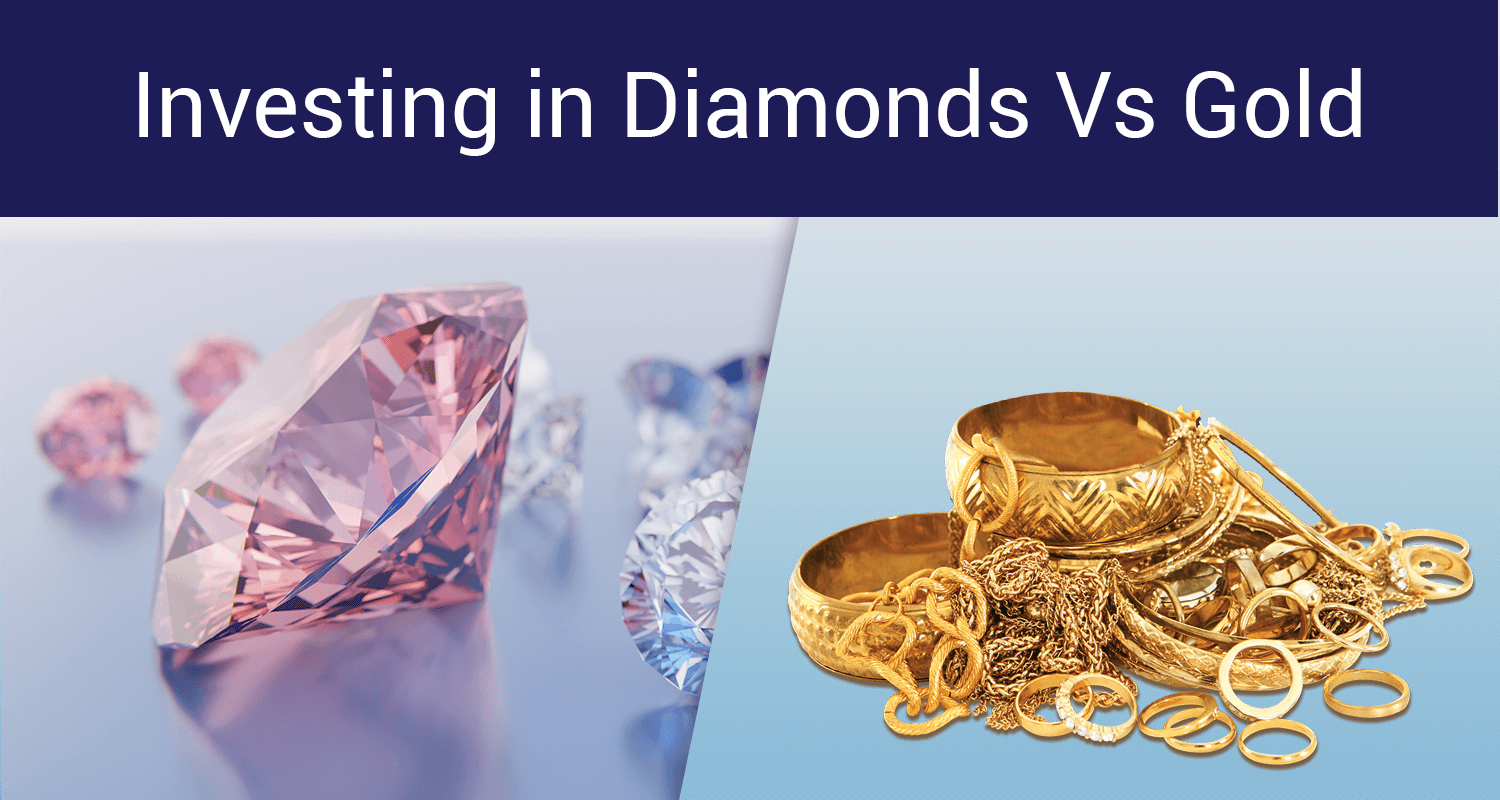
Diamonds Vs Gold - The Best Investment Option
Table of Contents
Gold vs Diamond: Overview
The debate of gold vs diamond has always been relevant, especially when it comes to choosing between emotional value and financial returns. In India, gold has traditionally been a preferred asset, while diamonds have gained popularity as a luxury and status symbol in recent years. Understanding the difference between the two is important before making any investment decision.
Gold has long been associated with wealth, security, and financial stability. It is commonly held in the form of jewellery, coins, or even financial instruments, and is often considered a reliable store of value. On the other hand, diamonds are primarily seen as luxury items, valued for their rarity and design appeal rather than standardised investment returns.
In this comparison of gold vs diamond, we will look at key investment aspects such as value retention, liquidity, pricing transparency, and long-term returns. This will help in understanding how both assets perform individually and which one may be more suitable based on your financial goals.
Factors that Affect the Investment: Gold Vs Diamond
Liquidity Comparison of Gold vs Diamond
One of the most important factors for consideration before investing in either gold/gold jewellery or diamonds, is its liquidity. Having an established global market with regular trading makes it easier to buy and sell gold. However, diamond/diamond jewellery is difficult to liquidate as it requires a buyer valuing specific characteristics of the diamond.
Value Retention: Gold vs Diamond
Another determinant that investors consider is the value of gold vs diamond. Generally, gold/gold jewellery is preferred because of its long history as a storehouse of value and wealth. Diamond/diamond jewellery on the other hand does not bring in a higher resale value as gold, owing to market demand and the presence of intermediaries in the diamond industry.
Price Stability and Market Trends
Gold prices are influenced by factors such as, demand-supply conditions, inflation and other economic conditions. Diamond prices fluctuate due to consumer demand, fashion trends and dynamics of the diamond industry. Nevertheless, gold prices are much more stable than the price of diamonds.
Investment Safety: Gold vs Diamond
Gold is a traditional haven for people who want to safeguard their money against major external circumstances. Diamonds are generally not considered a safety hedge against external conditions. Also, there is transparency when one buys gold, unlike diamonds which can also be synthetically produced.
Fungibility and Liquidity Explained
Gold is more fungible, meaning it can be exchanged for other assets of the same type unlike diamonds, which can be exchanged only when the other diamond is of same quality and meets the same specifics such as colour, cut, clarity and carat. This weakens its liquidity too.
Purity and Authenticity Factors
When it comes to gold karat vs diamond carat, there is no instance of gold being produced artificially so far. Diamonds, on the other hand, are made synthetically better than the naturally-sourced ones. Making diamonds artificially is also much cheaper than mining them traditionally. This means, pure gold is definitely rarer than diamonds.
Long-term Gains and Returns
With respect to diamond vs gold price, gold is sure to become stronger over time, even with the intermittent fluctuations. Gold makes for a viable asset class that reduces risk even while creating wealth. Diamonds on the other hand, do not enjoy price appreciation and hence cannot give the long-term gains as much as gold.
Loan Options Using Gold and Diamonds
When comparing diamond vs gold for loan purposes, it is important to understand how lenders evaluate these assets as collateral. Both gold and diamonds can be pledged, but their acceptance and valuation differ based on standard lending practices and regulatory alignment.
Gold is widely accepted by banks and NBFCs for secured loans due to its standardised purity, transparent pricing, and high liquidity. Lenders assess gold based on purity (generally up to 22K equivalent), net weight, and prevailing market price, and then apply the applicable Loan-to-Value (LTV) ratio as per regulatory norms and internal policies.
In contrast, diamonds are not commonly accepted as standalone collateral by most regulated lenders. This is because diamond valuation lacks uniform pricing standards and depends on multiple factors such as cut, clarity, colour, and certification. As a result, the diamond vs gold resale value differs significantly, with gold generally having more consistent and widely accepted resale value.
Key Differences in Loan Eligibility
- Gold Loans:
- Widely accepted as collateral by banks and NBFCs
- Valuation based on purity, weight, and market price
- Loan amount determined as per applicable LTV norms
- Diamond Jewellery Loans:
- Limited acceptance as collateral
- Valuation depends on quality parameters and certification
- May not be considered separately; often only gold portion is valued
Important Considerations
- In the context of diamond vs gold, gold is generally preferred for loans due to easier valuation and liquidity
- The diamond vs gold resale value highlights that gold typically offers more predictable value in financial transactions
- When investing in diamonds vs gold, it is important to note that only certain forms of gold are widely eligible for loan purposes under standard lending norms
For borrowing purposes, gold remains a more widely accepted and structured collateral compared to diamonds. Understanding the differences between diamond vs gold can help borrowers make informed decisions based on liquidity, valuation, and loan eligibility.
Conclusion
While some challenges to investing in gold jewellery such as verifying the rarity of gold and storing gold coins and bullion do exist, diamond jewellery carries the risk of not adding enough appreciation value over time.
Even as the debate about gold and diamonds as an investment class continues, it is quite unlikely that an individual does not invest in gold/gold jewellery as their life’s first investment in jewellery. Overall, it then appears that Gold turns out to be a preferred investment class.
However, when considering an investment, it is always advisable to check with a financial advisor or an expert in precious metals and gemstones before putting your money in either asset class.
At IIFL Finance, your precious gold jewellery stands an even better chance of adding more value to your life. IIFL Finance offers gold loan,gold loan for women and MSME gold loan among its other loans against gold offerings with gold loan interest rate. These loans are designed to meet the target group’s specific requirements.
Make the smart move! Apply for an IIFL Finance Gold Loan today and fulfil all your dreams!
Frequently Asked Questions
Is gold or diamond better for return value?
Gold usually tends to hold its value over time and hence offers a reliable hedge against inflation. On the other hand, diamonds might fetch a higher resale price. However in the case of diamonds, their value depends heavily on specific characteristics. So, a wise thing to do would be to choose gold for a secure investment, or if you are considering maximising your resale value, then a diamond would be a better option.
Will diamonds have resale value?
Gold can hold its initial price, but the same doesn't apply to diamonds. Because of retailer markups and fluctuations in the diamond market, you can expect to get significantly less when you sell your diamond jewellery. In fact, most pieces resell for between 25% and 50% of what you originally paid, depending upon jeweller to jeweller.
What is the return rate for diamonds?
While jewellers might offer 90% of the current market value if you sell your diamond jewellery outright, that number can be misleading. Experts say the true resale value is often closer to 90% because, unlike gold, diamonds can't be easily melted down and repurposed for new pieces. This means their value hinges on finding a buyer willing to pay for the specific stone you have. However, if you choose to exchange your diamond jewellery for something new within the store, some jewellers might offer a higher credit (between 90-100% of the current market price) to incentivise the exchange.
Can we exchange gold for diamond jewellery?
You can trade in old gold for any piece of diamond-studded jewellery crafted in 18kt gold. However, a standard deduction of 4% will be applied to the value of the old gold if you choose to exchange it for 22kt gold jewellery or a loose diamond. You will need to check with your jeweller for the same. Unfortunately, cash and gold coin exchanges are not available.
Is gold a better long-term investment than diamonds in 2026?
Gold is generally considered a better long-term investment than diamonds in 2026 due to stronger returns, higher liquidity, and consistent value appreciation. Unlike diamonds, which often lose resale value and are influenced by fashion trends, gold can be easily sold at transparent market prices. Investment options like Sovereign Gold Bonds, ETFs, or gold bars make gold the preferred choice for wealth preservation.
Why is gold preferred over diamonds during economic uncertainty?
Gold is generally preferred during economic uncertainty because it is a safe-haven asset. Unlike diamonds, which are mostly luxury items, gold preserves value, provides quick access to funds, and has standardised pricing. Historically, gold performs well when currencies weaken or inflation rises, offering stability, liquidity, and wealth protection.
What are the liquidity differences between gold and diamonds?
Gold is much more liquid than diamonds because of standard prices and can be traded internationally, whereas diamonds suffer from difficulties caused by subjective pricing according to four Cs, namely cut, color, clarity, and carat. Therefore, gold can easily be bought, sold, and exchanged almost anywhere without affecting its price.
Is gold easier to buy, sell, or exchange than diamonds?
Gold is simple in terms of purchase, sale, and exchange since it is widely accepted, making transactions smooth. The value of gold is up-to-date, based on global benchmark rates, avoiding misunderstandings. Diamond valuation is complicated and requires experts, which results in a high spread between buying and selling prices.
Disclaimer : The information in this blog is for general purposes only and may change without notice. It does not constitute legal, tax, or financial advice. Readers should seek professional guidance and make decisions at their own discretion. IIFL Finance is not liable for any reliance on this content. Read more