Gold Weight vs Net Gold Weight: How It Affects Your Gold Loan Value
Table of Contents
It is important to comprehend the processing and valuation method before applying for a gold loan to fulfil your financial needs. A lot of borrowers think that the overall weight of their jewellery dictates how much they will ultimately be able to borrow. Lenders, however, make a distinction between the net and total weight of gold. This distinction is important because, after excluding non-gold components, the loan value is determined only by the actual gold content. Understanding how gold weight, purity, and market valuation work together helps you assess your eligibility for a gold loan and secure the highest possible value for your assets. According to guidelines set by the Reserve Bank of India, borrowers can avail of a loan amount of up to 75% of the value of their pledged gold.
Difference Between Gold Weight and Net Gold Weight?
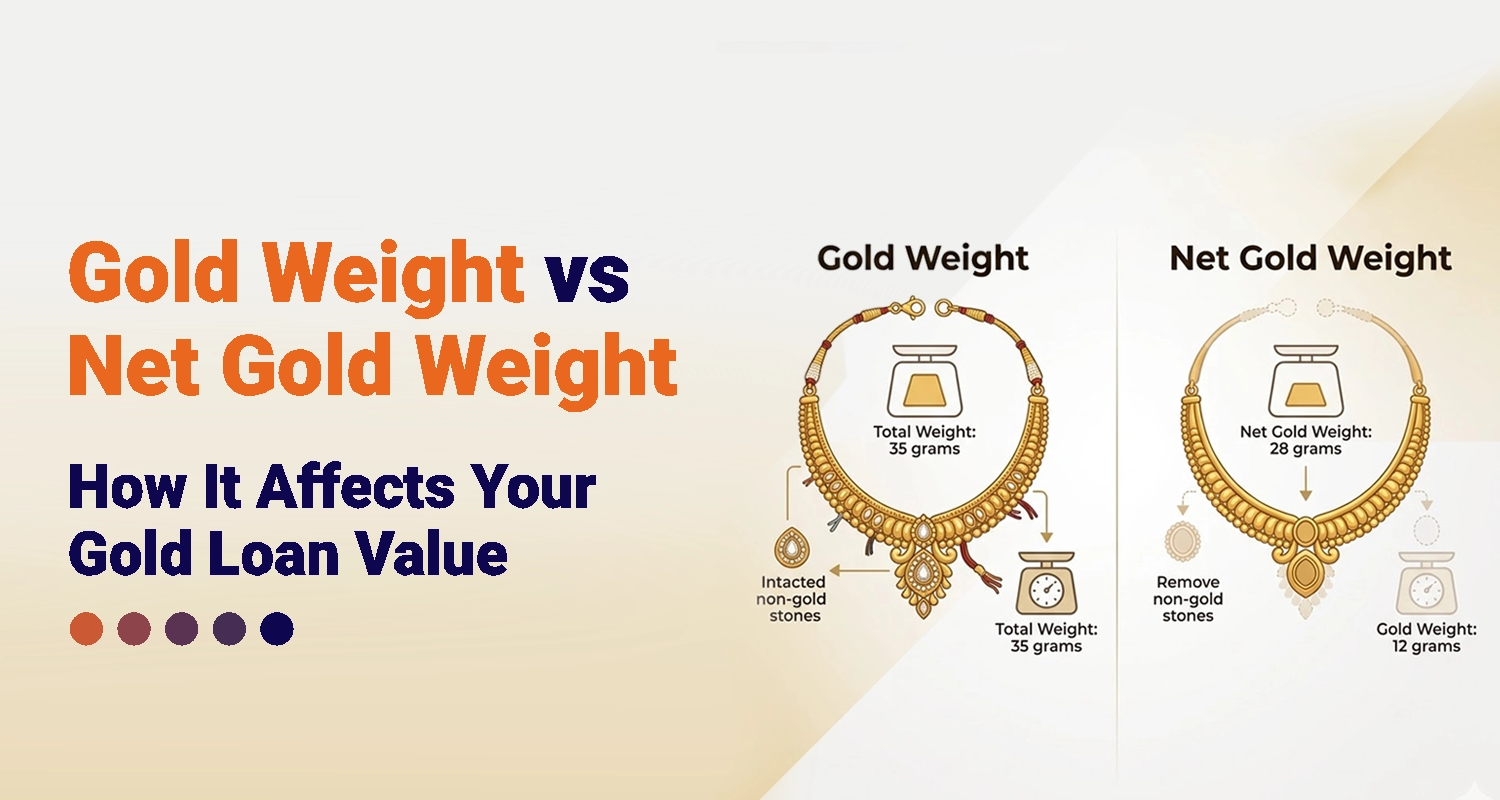
The first step in successfully navigating the loan procedure is to identify the two main weight categories that financial institutions employ - gold weight vs net gold weight. The whole weight of the item is referred to as its gross gold weight. This comprises the actual gold as well as any precious stones, ornamental beads, enamel work (Meenakari), and metal alloys that were used to provide the piece's structural support. The majority of jewellery is made with other metals to enhance durability because pure gold is inherently soft.
The weight of the pure gold content alone, on the other hand, is represented by the net gold weight in grams, which is obtained by physically or mathematically eliminating all non-gold components from it. The only number that lenders consider when comparing gold weight to net gold weight is this net amount. It is typical for borrowers to discover a difference between the weight shown on their original purchase invoice and the weight that the lender uses. This is because the former frequently contains the weight of ornamental components that are worthless under a credit facility backed by gold.
Understanding Net Gold Weight in Gold Loans
The net gold weight in grams is calculated by qualified professionals as part of the evaluation process for a gold loan. The lender distinguishes the value of pure gold from alloy metals, including copper, silver, or zinc, which are commonly used with gold to make 22K or 18K jewellery, during this assessment. In order to determine the actual gold value, any decorations such as thick threads, lac, or stones are carefully tallied and deducted from the overall weight.
In this computation, the most important aspect is gold purity vs weight for loan. A solid 22K gold bangle, for instance, will weigh significantly more in net weight than a 14K necklace of the same size due to the larger percentage of pure gold in the 22K item. The Karatage is confirmed by lenders using a purity-testing technique, guaranteeing that the borrower is given an impartial and open evaluation. This makes it possible for an ornament with a lower gross weight to nonetheless have a higher loan amount due to its high purity, giving the borrower a better financial outcome depending on the asset's quality.
Factors That Reduce Gross Gold Weight to Net Gold Weight
Knowing what is being subtracted is necessary to comprehend gold weight vs. net gold weight. Lenders point out several factors that don't affect the value of gold:
- Stones and Beads: Since the value of diamonds, emeralds, and even synthetic stones is not covered by a typical gold loan, they are not included.
- Enamel (Meenakari): The sum is deducted from the vibrant wax or glass-like substance utilised in traditional patterns.
- Lac/Wax Fillings: These non-gold components are frequently used to add robustness to hollow bangles or necklaces.
- Soldering Material: These are non-precious metal pieces used to fuse the various components of the jewellery.
- Alloy Composition: Based on the item's purity (Karatage), the precise proportion of base metals used to harden the gold.
Calculating Gold Loan Based on Net Weight
A long and fair evaluation is used to guarantee accuracy when calculating gold loans based on net weight. Finding the item's purity is the first step in the procedure, which is followed by calculating the net gold weight in grams. After using the current market rate for that particular purity, the lender uses the applicable Loan-to-Value (LTV) ratio to determine the final amount.
Assume that a borrower brings in two ornaments that, when weighed on a conventional scale, weigh precisely 40 grams each.
- Ornament A: An antique necklace with some semi-precious stones and extensive enamel work. The evaluation discloses that the non-gold components weigh 12 grams. There are 28 grams of net gold weight.
- Ornament B: The plain gold chain is a straightforward 22K chain with little soldering. The deduction for alloy and non-gold is just 2 grams. It weighs 38 grams of net gold.
Ornament B is going to attract a far bigger loan amount, even if the gross weight of the two objects is the same, because that is how net gold weight affects gold loan. The lender ensures a transparent and professional transaction for the borrower by concentrating on the net weight and offering a loan that is firmly supported by the gold's true market value.
How Net Gold Weight Affects Your Gold Loan Value
Understanding how net gold weight affects gold loan amounts is essential for every borrower. Your ability to borrow is primarily determined by your net gold weight in grams, which also has a direct impact on the total amount of money you may access. The purer gold you have, the more liquidity you can provide because the gold loan is an asset-backed credit facility. Both the lender and the borrower are protected by this emphasis on net weight, which guarantees that the Loan-to-Value (LTV) ratio is applied to a steady and realistic asset value.
Benefits of a value based on high net gold weight include:
- Increased Borrowing Power: Increase the amount of gold you pledge to increase your borrowing power.
- Transparent Valuation: Clear deductions guarantee that there are no hidden charges throughout the evaluation process.
- Quick Loan Approval: A more seamless approval process is the result of accurate weight evaluation.
- Quick and Simple Disbursals: Funds are sent to your account quickly after the net weight and purity are verified. The credit evaluation procedure is made simpler by the gold's inherent worth, which requires little documentation.
- Securing Gold Pledged: Your valuables are kept in top-notch, secure
Being aware of the difference between gold weight vs net gold weight ensures that your expectations are reasonable, which will result in a more positive borrowing experience with attractive interest rates*.
Gold Purity vs Weight for Loan: What Matters More?
When deciding which assets to pledge, many borrowers ask about gold purity vs weight for loan, specifically, which one drives the value higher? A prevalent misunderstanding among borrowers is that a larger loan would necessarily be associated with a heavier piece of jewellery. However, in the world of professional lending, the weight of the loan and the purity of the gold are taken into account jointly. The "quality" component is purity, while the "quantity" component is net weight. A 10-gram 24K gold coin may have a comparable or greater loan value than a 14K gold pendant weighing 15 grams, since 24K gold is pure. This is how net gold weight affects gold loan, depending on the actual percentage of pure gold present after subtracting alloys.
The "gold equivalent" of your jewellery is what lenders seek after. Your loan amount will be lowered if you have hefty decorations with low purity since the lender will have to subtract the alloys' substantial weight. On the other hand, jewellery that is light yet pure might be valued more per gram. You may pick which pieces to pledge strategically to receive the Maximum Value for Gold* and ensure the easy release of gold when your payback is finished by knowing how net gold weight impacts the value of your gold loan.
Frequently Asked Questions
What is the difference between gold weight and net gold weight?
An ornament's gross weight includes all of its alloys, stones, and enamel. Net gold weight is the weight of the pure gold that is really there. To provide you with attractive interest rates and a fair agreement free of surprises, lenders utilize net weight to determine the worth of your loan.
How is net gold weight measured during a gold loan appraisal?
To determine the amount of gold present, appraisers utilise trained weighing scales and purity-testing equipment (such as XRF machines or stone-weight deduction tables). In addition to confirming the Maximum Value for gold* based on current market trends and the exact purity of gold items, this expert appraisal guarantees quick loan approval.
How does net gold weight in grams affect gold loan eligibility?
The net weight in grams of gold determines your eligibility. Because a higher net weight translates into a higher market worth, the lender may give a bigger loan amount. This open and honest procedure requires a minimal documentation process and makes sure that your borrowing is secured by your assets.
Can jewellery with stones still be used for a gold loan?
Yes, jewellery with stones is permitted. The net weight of gold, however, is calculated by subtracting the weight of the stones from the gross weight. Quick and easy disbursals are still available to you, and you can be sure that the high-security vaults are protecting the gold you promised.
Does higher purity always guarantee a higher gold loan value?
A higher purity raises the value per gram, but the net weight determines the overall price. High purity and high net weight work together to guarantee the maximum value of gold*. Additionally, if borrowers want to shut their accounts early, there are zero foreclosure charges* associated with our loans.
Disclaimer : The information in this blog is for general purposes only and may change without notice. It does not constitute legal, tax, or financial advice. Readers should seek professional guidance and make decisions at their own discretion. IIFL Finance is not liable for any reliance on this content. Read more